Views: 0 Author: Site Editor Publish Time: 2026-10-26 Origin: Site
Packaging procurement requires balancing material performance, unit economics, and environmental compliance. Selecting the wrong paper grade leads to compromised barrier protection or unnecessary budget bloat. This oversight can quickly derail a product launch or disrupt your entire supply chain. Both glassine paper and Machine Glazed (MG) paper offer smooth finishes. Manufacturers frequently use them in flexible packaging, causing considerable overlap in buyer evaluations. You might find yourself comparing these two options without a clear technical framework. This guide provides an objective, specification-driven breakdown of how these materials truly differ. We will explore their distinct production methods, core physical properties, and best commercial applications. By understanding these specific technical metrics, you can confidently finalize your packaging strategy and choose the exact material your product requires.
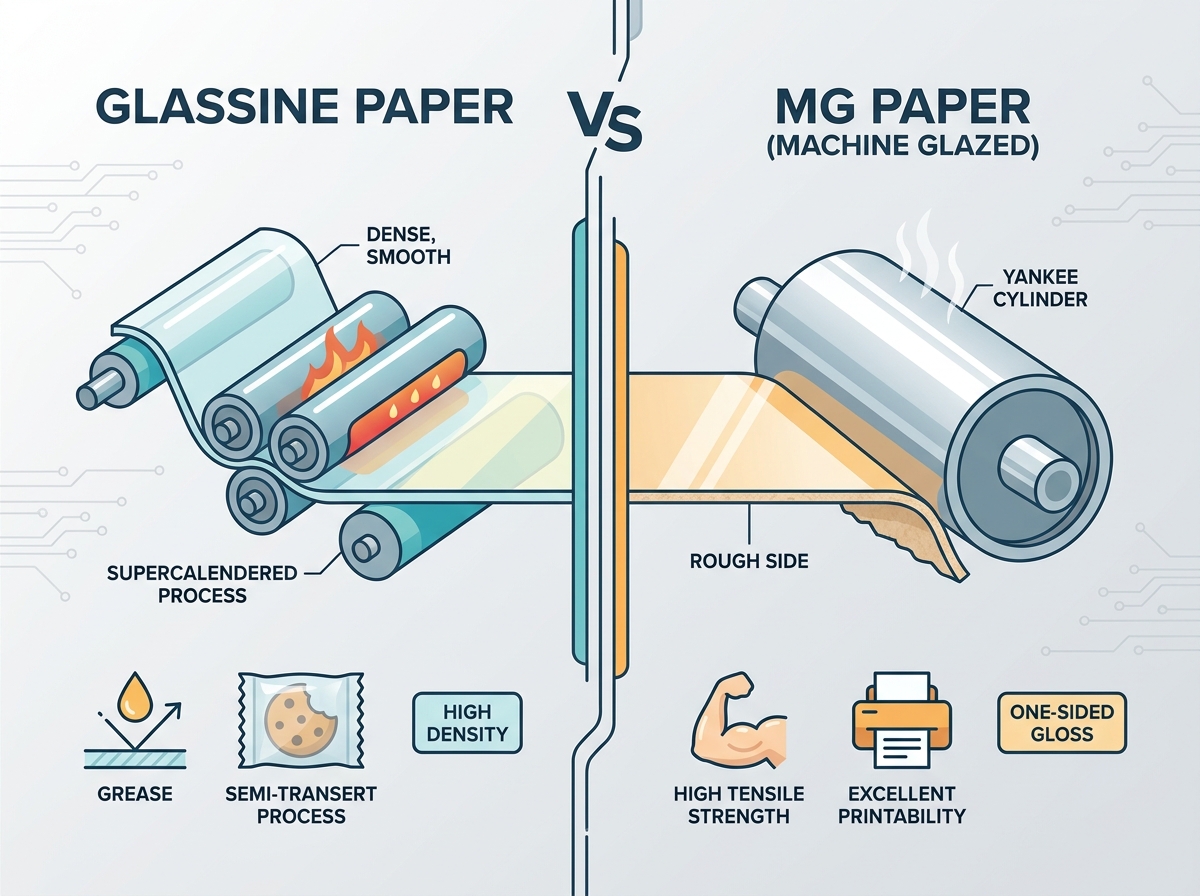
Glassine paper is supercalendered, resulting in a dense, highly smooth, translucent material with natural grease resistance (without chemical coatings).
MG paper is dried on a Yankee cylinder, creating a paper with one glossy side and one slightly rough side, prioritizing high tensile strength and printability.
Barrier vs. Strength: Choose glassine for grease/air barrier properties and premium translucent aesthetics; choose MG paper for structural wrapping, lamination bases, and cost-effective bulk packaging.
Cost Implications: Glassine generally commands a higher price point due to its energy-intensive manufacturing process compared to standard MG kraft or tissue.
Production methods entirely dictate final material capabilities. You must understand how mills process these papers to grasp their differing performance limits. The physical machinery used shapes the paper down to the cellular level. We will examine the specific engineering behind both materials.
Mills subject the base paper to highly aggressive refining processes. Operators beat the wood pulp extensively until the fibers become gelatinous. They then send this refined web through a supercalender machine. A supercalender consists of a vertical stack of alternating rollers. Some rollers use polished steel, while others feature compressed fiber coatings. These rollers apply extreme pressure and high heat to the moving web.
This intense mechanical action flattens the cellulose fibers completely. It crushes the internal structure and removes almost all air pockets. This structural change creates inherent translucency and incredibly high density. The material develops a naturally grease-resistant surface on both sides simultaneously. You achieve this protective barrier without applying any external chemical coatings.
MG paper relies on a completely different drying methodology. Mills utilize a Yankee cylinder drying process to create this material. The machinery presses a wet paper web directly against a massive, steam-heated cylinder. This cylinder features a highly polished steel surface. The paper dries instantly upon contact.
This unique drying technique creates a distinct two-sided paper. The side touching the cylinder becomes highly glazed and glossy. The reverse side faces outward and remains uncalendered. This exposed side feels rougher to the touch. Because the material does not pass through heavy supercalender rollers, it retains more bulk. It keeps a higher level of natural porosity compared to heavily compressed alternatives.
Packaging engineers require side-by-side technical evaluations to make informed choices. Material performance dictates how well your product survives transit and retail display. The following breakdown compares core metrics vital to packaging integrity.
Material Performance Comparison Chart
Property | Glassine Paper | MG Paper |
|---|---|---|
Grease Resistance | High (Natural) | Low (Requires coating) |
Opacity Level | Translucent | Opaque |
Tensile Strength | Moderate | High |
Tear Resistance | Low (Brittle) | Excellent |
Surface Finish | Smooth on both sides | Glossy one side, rough reverse |
glassine paper offers exceptional natural resistance to grease and fats. Its extreme fiber density stops oil molecules from penetrating the substrate. It also provides moderate moisture resistance for short-term exposure. MG paper possesses low natural grease resistance out of the gate. Uncoated MG grades absorb oils quickly. You must chemically treat or coat it to stop grease migration. Converters typically apply wax or polymer extrusions to achieve necessary barrier targets.
Supercalendered materials are naturally semi-transparent. This unique visual property allows consumers to see the product enclosed inside. Many brands utilize this peek-through effect for premium unboxing experiences. MG paper remains generally opaque across all basis weights. You can easily source it in bright bleached white or natural unbleached brown. It offers excellent light protection. It also provides solid structural concealment for less visually appealing industrial items.
Heavy mechanical refining alters paper strength profiles significantly. Glassine behaves in a relatively brittle manner. It exhibits lower tear resistance because mills beat the fibers so aggressively. The material is highly prone to creasing upon impact. MG paper prioritizes structural integrity above all else. It delivers high mechanical strength and exceptional tear resistance. You will achieve excellent runnability when using it on automated packaging lines.
You must map material features directly to specific industry outcomes. Choosing the right substrate depends entirely on the end-use environment. Let us examine the ideal use cases for each option.
Certain industries demand strict chemical purity and visual elegance. We see this material dominate the following sectors:
Food packaging: It excels as wrappers for baked goods and confectionery items. It provides robust grease barriers without relying on PFAS or plastic layers.
Archival and art protection: Galleries demand acid-free interleaving materials. This paper prevents smudging and protects delicate illustrations from friction.
Premium retail: High-end cosmetics and apparel brands leverage its distinct look. The smooth, translucent aesthetic elevates the perceived value of luxury goods.
Philately and coin collecting: Collectors utilize small translucent envelopes to store rare stamps. The material protects items while keeping them visible.
Industrial and high-volume consumer goods require durability. MG paper thrives in these demanding scenarios:
Lamination and coating base: The rough reverse side adheres flawlessly to adhesives and aluminum foils. The glossy side prints beautifully.
Flexible food wrappers: Once coated, it functions perfectly for bulk sugar bags, flour bags, and fast-food tray liners.
Medical and industrial packaging: Hospitals require reliable sterile barriers. The strong fibers provide the high puncture resistance needed for surgical tool pouches.
Protective void fill: Warehouses crumple lightweight unbleached grades to protect fragile items during shipping.
Modern supply chains face intense regulatory and environmental scrutiny. Your packaging choices directly impact your corporate sustainability reporting. We must address how these materials perform at the end of their lifecycles.
Both materials are inherently biodegradable by nature. They break down easily in composting environments. You can recycle them in standard municipal paper streams if they remain uncoated. However, you must highlight the risks associated with coated variations. MG paper loses its basic recyclability if converters coat it with Polyethylene (PE). Brands often apply PE to mimic the natural barrier properties found in supercalendered alternatives. This polymer layer contaminates paper pulping vats and disrupts recycling streams entirely.
Global regulators are actively banning harmful packaging chemicals. Evaluating the importance of sourcing PFAS-free materials is non-negotiable today. glassine paper utilizes pure physical density to stop grease. It offers a 100% chemical-free grease barrier out of the box. This aligns perfectly with strict compliance frameworks and FDA mandates.
You must also assess pulp bleaching methods for both materials. Always verify if your supplier uses Totally Chlorine-Free (TCF) or Elemental Chlorine-Free (ECF) processes. These advanced bleaching processes eliminate toxic wastewater runoff. Choosing unbleached brown grades further reduces your overall environmental footprint.
Purchasing decisions require a structured framework. You must evaluate order minimums, printing limitations, and production speeds. A solid procurement strategy prevents costly manufacturing delays.
MG paper typically proves more cost-effective per ton. The Yankee drying process is highly efficient at scale. This makes it ideal for high-volume, low-margin applications. Fast-food chains rely heavily on this economic advantage. Glassine represents a premium financial investment. Its higher price point is justified by its dual aesthetic and barrier functions. The supercalendering process consumes immense amounts of electricity. You are directly paying for this energy-intensive manufacturing process.
Factory floor performance dictates your final conversion costs. MG paper delivers exceptional printability on its glazed side. It accepts flexography and offset inks effortlessly. The strong web handles tension well on high-speed converting machines. Glassine certainly can be printed. However, the process requires specific technical adjustments. You must use fast-drying or UV-cured inks due to the material's extremely low porosity. Press operators must implement careful handling procedures to avoid surface scuffing.
You must define typical Minimum Order Quantities (MOQs) during early vendor discussions. Premium translucent grades often carry higher MOQs than standard kraft variants. Lead times can stretch depending on mill capacity and bleaching requirements. We stress the importance of requesting material samples early. You need these samples for critical pilot testing. Run them aggressively on your existing packaging lines to verify tension limits and folding compatibility.
Packaging selection demands a clear understanding of material science. Glassine offers a dense, translucent, natural barrier. It achieves oil resistance entirely through mechanical compression. MG paper offers exceptional tear strength, high-speed machinability, and a distinct one-sided gloss. It relies on a unique cylinder drying process to achieve its bulk.
Your final decision framework relies on core product needs. If your product requires grease resistance and a premium "peek-through" aesthetic without plastic, choose glassine. If you need structural strength, high-volume cost efficiency, or a reliable base for lamination, choose MG paper. Both substrates deliver excellent results when matched to the right application.
Take immediate action to validate your choice. Prompt your supplier to provide a detailed technical data sheet (TDS). Order sample rolls to run physical trials. Consult with a flexible packaging specialist to properly evaluate machine compatibility on your specific factory floor.
A: No, they are different. While both resist grease, their manufacturing processes vary. Mills beat the pulp for greaseproof paper heavily, but they do not supercalender it to the same extreme degree. Therefore, greaseproof paper lacks the high transparency, glossy finish, and ultra-dense structure characteristic of true supercalendered alternatives.
A: The difference lies entirely in the finish. MF paper passes through standard steel calendars, resulting in a matte, relatively uniform finish on both sides. MG paper dries on a massive Yankee cylinder. This specialized cylinder creates one highly glossy, glazed side while leaving the reverse side slightly rough.
A: You should avoid this practice. Art-grade production focuses strictly on acid-free archival properties to protect paintings. Food-grade production requires FDA-approved hygienic manufacturing environments. Food-grade materials also strictly prohibit the use of toxic sizing agents or non-compliant optical brighteners during the pulping process.
A: Neither material seals naturally on its own. They are primarily composed of natural cellulose fibers. Both require a specific heat-seal coating applied by a converter. Alternatively, you must use a cold-seal adhesive application for them to function correctly on automated Form-Fill-Seal (FFS) bagging lines.