Views: 0 Author: Site Editor Publish Time: 2026-10-22 Origin: Site
The global shift away from single-use plastics is accelerating rapidly. It forces brands across all industries to rethink their packaging strategies. They must evaluate sustainable alternatives without compromising product integrity, safety, or shelf life. Procurement teams and packaging engineers face a tough challenge daily. They often question if paper-based materials can step up to the plate. Specifically, they wonder if paper can provide the necessary barrier protection and tamper-evidence historically guaranteed by traditional poly-bags.
We see a clear solution emerging in the market. glassine paper offers a unique combination of physical density, chemical purity, and natural translucency. It secures products against contamination and tampering effectively. You can rely on its robust mechanical properties to protect sensitive goods. However, success depends entirely on how you integrate it. You must account for its specific sealing and barrier limitations within your supply chain to achieve optimal security.
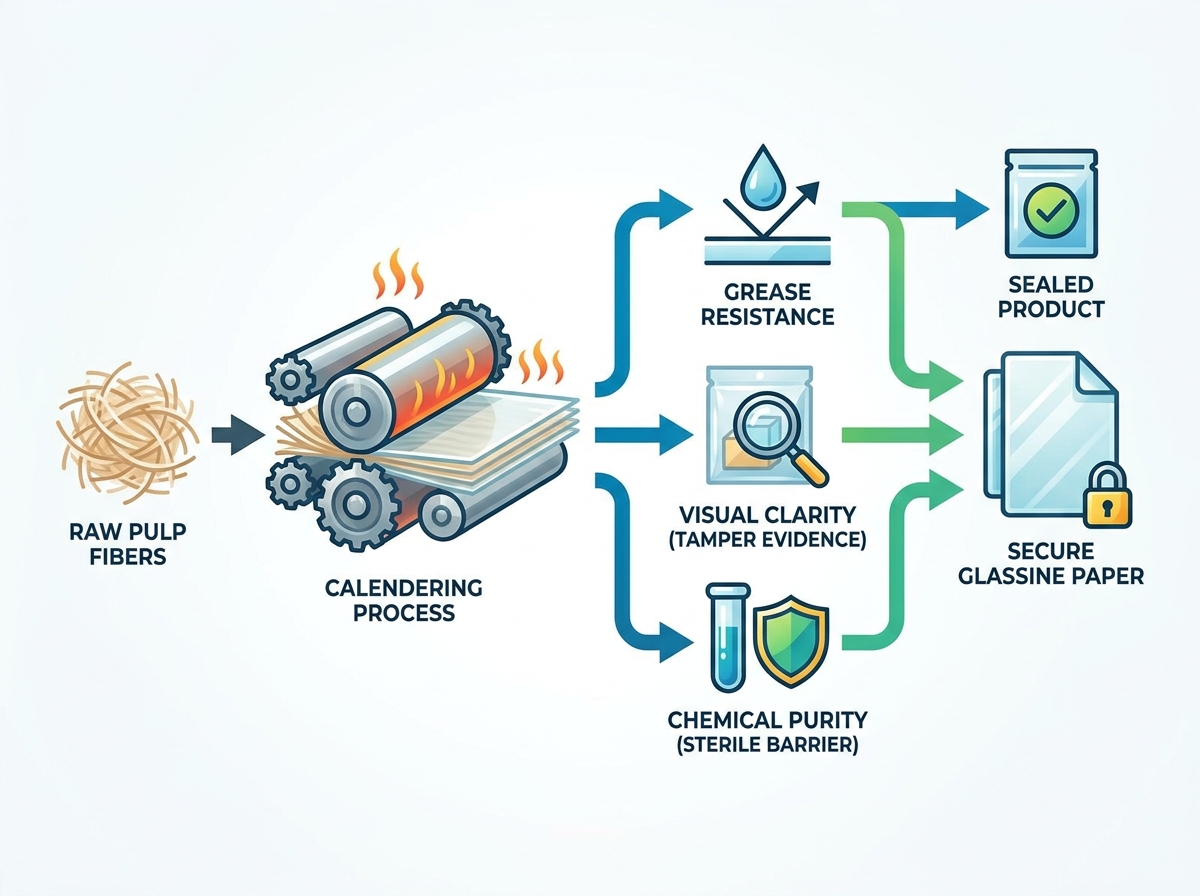
Natural Barrier Protection: The rigorous calendering process gives glassine paper inherent resistance to grease, oil, and air without relying on chemical coatings or waxes.
Visual Integrity: Natural translucency allows for immediate visual inspection of contents and rapid identification of tampering or package breaches.
Sterilization Compatibility: Medical-grade glassine permits ethylene oxide (EO) gas penetration while maintaining a sterile barrier post-processing.
Implementation Reality: While highly secure against grease and debris, glassine requires specific adhesive strategies (as it does not naturally heat-seal) and is not fully waterproof for high-moisture environments.
Moving from poly-plastics to paper introduces real anxieties for modern businesses. Companies worry intensely about product contamination during transit. They stress over chain-of-custody visibility and strict regulatory compliance. When you replace a reliable plastic barrier, you must ensure the new material performs under pressure. Brands cannot afford a spike in damaged goods or compromised safety. A failed packaging transition harms brand reputation and erodes consumer trust.
You must define what packaging security actually means for your operations. We look at security through a highly structured lens. In this context, security encompasses three foundational pillars.
First, physical security stands as the primary defense line. This involves resistance to tearing and puncturing during handling. It also includes visible tamper evidence. If unauthorized access occurs, the packaging must show immediate, irreversible damage.
Second, environmental security dictates shelf life. The material must provide a strong defense against external contaminants. Think about warehouse dust, industrial grease, and ambient odors. These elements easily ruin unprotected textiles or food items.
Third, chemical security protects the end user. This ensures zero migration of harmful substances. The packaging must not leach chemicals into the product. This rule remains absolutely vital for the food, cosmetics, and pharmaceutical sectors.
The manufacturing process defines the physical capabilities of this material. The mechanism relies on supercalendering. Manufacturers press pulp fibers flat under massive high pressure and intense heat. The massive steel rollers iron the cellulose fibers together. This aggressive mechanical action removes internal air pockets entirely. It closes the paper's natural porosity.
The outcome delivers exceptional physical security. You get a dense, incredibly smooth surface. This dense structure physically blocks dust, dirt, and airborne contaminants far better than standard kraft paper. While kraft paper has loose fibers, supercalendered material creates a tightly woven microscopic shield. It prevents micro-debris from settling on delicate products like electronics or artisan soaps.
Contamination defense ranks high on any procurement engineer's priority list. The mechanism behind this resistance is purely physical. The highly non-porous surface naturally repels lipids. It achieves this remarkable feat without adding harmful PFAS (per- and polyfluoroalkyl substances). It avoids polyethylene plastic coatings completely. The flattened fibers simply leave no space for oil molecules to penetrate.
The practical outcome solves major headaches for food and cosmetic brands. It prevents oils from baked goods or rich face creams from leaching out. Simultaneously, it stops external warehouse oils or machine lubricants from seeping in. The structural integrity remains strong throughout the supply chain. You avoid the unsightly grease spots commonly seen on standard paper packaging.
Supply chain visibility ensures operational efficiency. The mechanism here relates to the extreme fiber flattening. Pressing the fibers so tightly together removes light-scattering air gaps. This allows ambient light to pass right through the sheet. We call this natural translucency.
The operational outcome is highly valuable for quality assurance. Fulfillment centers, QA teams, and end-consumers can verify product presence instantly. They can assess the item's condition without breaking the protective seal. Furthermore, it provides excellent passive tamper evidence. If someone attempts to open the package, the tight fibers tear rather than stretch. Any tearing or adhesive removal becomes immediately visible. Utilizing glassine paper ensures your customers know they received a pristine, untouched item.
Chemical security protects consumers from invisible threats. The mechanism relies on strict raw material sourcing. Quality mills manufacture this substrate predominantly from 100% virgin wood pulp. They typically leave it unbleached. Alternatively, they process it using entirely chlorine-free (PCF) methods. This avoids the introduction of toxic bleaching byproducts.
The outcome guarantees unmatched chemical purity. The final product is pH neutral and completely acid-free. It leaves no chemical residue on the enclosed items. This ensures long-term archival security for sensitive documents or fine art. More importantly, it prevents the chemical degradation of medical instruments or delicate food flavors. You can store items for years safely.
Comparing materials directly helps you make informed procurement decisions. You must understand where paper excels and where plastics still hold an advantage. The breakdown below highlights the critical differences.
Table: Packaging Material Performance Comparison
Feature / Material | Polybags (LDPE) | Wax-Coated Paper | Supercalendered Paper |
|---|---|---|---|
Grease Resistance | High | High | High |
Moisture Barrier | Excellent (Waterproof) | Good (Water-resistant) | Low (Susceptible) |
Breathability | None (Traps Moisture) | Low | Moderate (Prevents Mold) |
End-of-Life Disposal | Landfill / Specialized Recycling | Difficult to Recycle | Curbside Recyclable & Compostable |
Tamper Evidence | Poor (Stretches) | Moderate | Excellent (Visible Tear) |
Versus Polybags (LDPE/HDPE), the advantages are largely environmental and organic. The paper breathes slightly. It will never trap internal condensation. This tiny airflow reduces mold risk significantly for organic goods, artisan foods, and leather items. Additionally, it is fully curbside recyclable and backyard compostable. However, you must accept a major disadvantage. It possesses an inferior moisture barrier. Submerging it in water causes rapid degradation. Exposing it to heavy rain will destroy the package.
Versus Wax-Coated Paper, the benefits focus on chemical purity and recycling. Wax paper utilizes petroleum-based coatings. These waxes can transfer to products under high heat. Worse, they severely hinder recyclability at municipal facilities. glassine paper achieves similar grease resistance purely through mechanical manufacturing. It remains a pure cellulose product. The disadvantage is that wax paper offers a stronger moisture barrier. You can also heat-seal wax paper much more easily using standard factory equipment.
Meeting global compliance standards separates professional packaging from amateur attempts. You must prove your materials are safe for consumers and the environment. We recommend tracking three main regulatory areas.
Food Contact Certification (FDA & EFSA): You must verify the material is designated as food-grade. It should carry a Generally Recognized As Safe (GRAS) status. This certification proves no toxic migration occurs upon direct contact with consumables. Your supplier must provide documentation showing compliance with US and European food safety laws.
Medical Sterilization Protocols: Medical-grade variants undergo rigorous testing. Facilities utilize this material in autoclave environments and ethylene oxide (EO) gas sterilization chambers. The porous nature allows sterilizing gas to enter. Once removed from the chamber, the tortuous path of the fibers acts as a reliable microbial barrier post-sterilization.
Sustainability Tracking (FSC & PEFC): Securing your supply chain means verifying the origin of your wood pulp. You must protect against illegal logging. Source exclusively from Forest Stewardship Council (FSC) or Programme for the Endorsement of Forest Certification (PEFC) certified forests. This provides complete traceability from the forest floor to your warehouse shelf.
Ignoring these standards exposes your business to massive liability. Always request up-to-date compliance certificates before signing a procurement contract.
Adopting sustainable materials requires operational adjustments. You cannot simply drop paper into a machine calibrated for plastic. Understanding the implementation risks ensures a smooth transition.
Sealing challenges represent the most common operational hurdle. Because it lacks plastic or wax layers, standard variants cannot be heat-sealed. The heat simply burns the paper. The solution requires evaluating cold-seal adhesives. You can also explore mechanical crimping techniques. If you absolutely need heat sealing, investigate specialized variants. These advanced options add ultra-thin, compostable eco-coatings to enable thermal bonding.
Supply chain humidity limits pose a serious logistical risk. The material performs poorly in sustained high-humidity environments. If you ship products via ocean freight without climate control, you risk compromised packaging. Risk mitigation is straightforward. Conduct extensive transit testing. Ensure your outer tertiary packaging provides the necessary primary moisture defense. Use robust corrugated boxes to shield the primary paper packaging from ambient humidity.
Supplier validation requires technical diligence. Do not select a vendor based solely on unit cost. Shortlist suppliers based on verified burst strength tests. Ask for their Mullen test results to understand puncture resistance. Review their opacity ratings to ensure proper visual transparency. Verify their ISO certifications for quality management. A cheap supplier often delivers inconsistent fiber density, which ruins the contamination defense.
The final verdict on this material is highly positive. It is a highly capable, secure packaging material for modern brands. If you prioritize sustainability, grease resistance, and visual integrity, this is an exceptional choice. It physically blocks contaminants and provides immediate tamper evidence. You simply need to ensure your specific product does not require an absolute, waterproof moisture barrier.
Your next steps involve careful procurement planning. Packaging teams should request material data sheets (MDS) from potential vendors immediately. Verify all FDA, EFSA, and FSC compliance claims. Before committing to a full operational rollout, run limited-batch transit tests. Focus specifically on adhesive failure rates and tear strength across different climate zones. Taking these calculated steps guarantees a successful, secure transition to eco-friendly packaging.
A: Yes, when sealed with appropriate destructive-bond adhesives, the smooth, tight fibers of glassine will visibly tear when opened, indicating tampering.
A: No. Authentic glassine achieves its grease resistance mechanically via calendering, making it entirely free of "forever chemicals" and plastics.
A: It is water-resistant against brief splashes or dampness, but it is not waterproof. It is not suitable as a primary barrier against sustained moisture.
A: Yes, it is acid-free and pH neutral, preventing the chemical breakdown of the paper from damaging the secured contents over time.