Views: 0 Author: Site Editor Publish Time: 2026-05-25 Origin: Site
The transition from generic void-fill to strategic branded unboxing experiences is a direct response to rising customer acquisition costs. Retailers must maximize every customer interaction. They realize first impressions heavily influence repeat purchases. For e-commerce and retail brands, tissue paper is no longer just protective wrapping. It represents a critical touchpoint for brand recall. Customers unbox products and judge your brand immediately. A memorable unboxing experience encourages social sharing. It transforms single-time buyers into vocal brand advocates.
Evaluating current trends isn't about chasing aesthetics. It revolves around matching material capabilities to your business outcomes. You must balance inks, paper weights, and sustainability metrics against operational budgets. We will explore how modern packaging drives retention. You will learn to navigate printing methods, evaluate suppliers, and leverage interactive designs effectively.
Sustainability is a baseline, not a premium: FSC-certified paper and soy-based inks are now industry standards required to meet consumer disposal expectations.
Vibrancy requires specific print methods: Achieving vibrant custom printed tissue paper for gifts requires aligning your artwork with the right printing technology (digital vs. flexographic).
Operational viability hinges on GSM and MOQs: Scaling customized packaging requires balancing tissue weight (durability) against Minimum Order Quantities (cash flow).
Interactive packaging drives retention: QR codes and hidden secondary messaging printed on tissue are converting static gift wrapping into measurable marketing channels.
Generic packaging fails to reinforce brand equity post-purchase. Customers receive plain brown boxes and immediately discard the filler. They do not remember the merchant. Conversely, rigid custom boxes are often cost-prohibitive for high-volume shipping. E-commerce brands face squeezing margins. They need a middle ground to delight customers.
Effective custom packaging must accomplish several distinct goals simultaneously. It must deliver immediate visual impact upon opening. It must protect lightweight items from scuffing during transit. Finally, it must maintain a strictly low per-unit cost. You cannot afford to spend dollars on packaging when selling low-margin consumer goods. Cents matter in high-volume fulfillment environments.
Brands are strategically shifting their packaging spend. They move budgets away from heavy external cardboard printing. External boxes get dirty and damaged during the shipping process. Instead, brands invest in premium internal unboxing layers. They focus on the interior presentation. This improves both perceived value and supply chain logistics. Beautiful internal layers stay pristine. They greet the customer exactly as intended.
Keep external boxes minimally branded to deter package theft.
Concentrate bright colors and detailed logos on the internal tissue layers.
Use custom stickers to seal the tissue, adding an extra layer of anticipation.
Modern consumers actively penalize brands for excessive plastic waste. The industry now prioritizes circular packaging materials. We see a massive shift in substrate trends. The move away from virgin wood pulp is accelerating rapidly. Brands now favor post-consumer waste (PCW) recycled tissue. FSC-certified sourcing represents the new baseline. You must prove your paper comes from responsibly managed forests.
Ink realities have also evolved dramatically. Traditional petroleum-based inks harm the environment. They prevent paper from breaking down cleanly. Manufacturers are replacing them entirely. They use soy or water-based alternatives instead. This ensures the Custom Printed Tissue Paper remains fully compostable. It keeps materials safely curbside recyclable. Customers appreciate seamless disposal options.
Marketers must verify supplier sustainability claims strictly. You cannot simply accept vague "eco-friendly" marketing copy. This exposes your brand to severe greenwashing risks. Require verifiable certifications during the procurement process. Look for FSC, PEFC, or recognized ISO eco-labels. Ask your supplier for their compliance documentation before placing any bulk orders.
Assuming all brown Kraft paper is automatically recycled or sustainable.
Using metallic foils or UV spot gloss, which render the paper non-recyclable.
Failing to communicate the packaging's compostability to the end consumer.
Choosing the right print method dictates your final visual output. Your solution category involves careful print method selection. You must decide between flexographic and digital printing technologies. Each carries specific advantages for different operational scales.
Flexographic printing is best for simple, repeating brand logos. It excels during large-scale production runs. The process is highly cost-effective per sheet. However, it is limited in color complexity. You typically use one or two spot colors.
Digital printing solves complex design challenges. It is necessary for multi-color patterns. It easily produces Vibrant Custom Printed Tissue Paper for Gifts or limited seasonal campaigns. Digital presses support complex gradients and photographic elements. However, this flexibility comes at a higher per-sheet premium.
Feature | Flexographic Printing | Digital Printing |
|---|---|---|
Best Use Case | High-volume runs, simple repeating logos | Short runs, highly colorful artwork, seasonal designs |
Color Complexity | Limited (1-3 spot colors usually) | Unlimited (CMYK, complex gradients) |
Setup Costs | High (requires custom printing plates) | Low (no plates required) |
Per-Unit Cost at Scale | Very Low | Moderate to High |
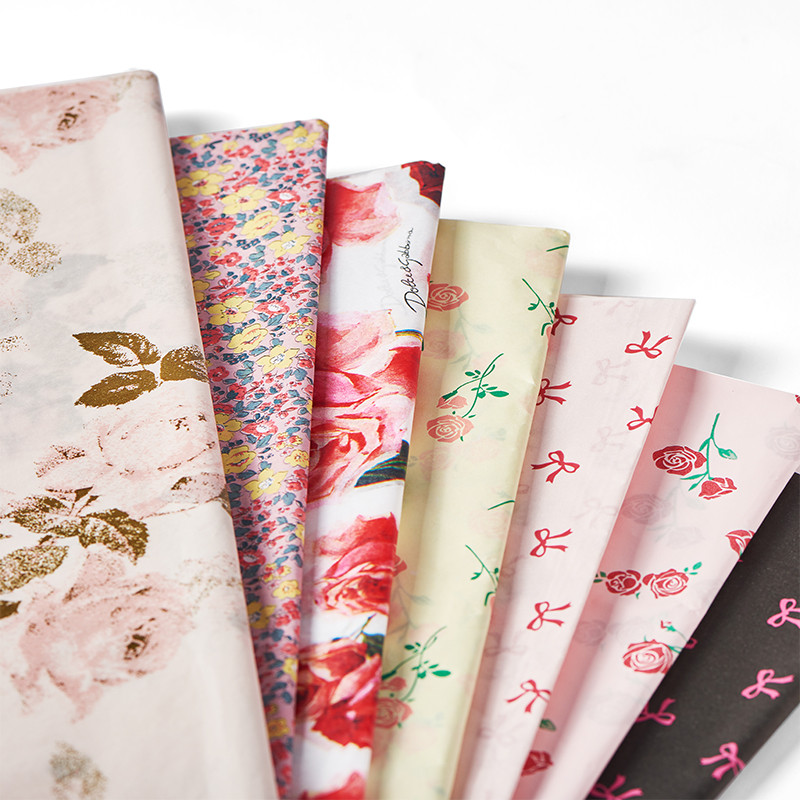
Design considerations are shifting rapidly. We notice a distinct trend toward maximalist aesthetics. Brands deploy edge-to-edge patterns freely. They use Pantone-matched brand colors relentlessly. This bold approach elevates standard presentation significantly. It makes the package feel like a luxury gift rather than a basic commodity.
However, implementation risks exist. Dark, heavy ink saturation on thin paper creates problems. The paper cannot absorb excessive ink perfectly. This can lead to "ink rub-off" onto your actual products. It also creates a stiff, crinkly texture. This ruins the soft, premium feel. Always balance your design saturation against the paper's absorption capacity.
Static packaging represents a missed marketing opportunity. The solution category lies in deep marketing integration. Modern brands embed scannable elements directly into their packaging. They integrate QR codes and NFC chips into the repeating tissue pattern. This active engagement drives immediate reorders. It encourages seamless warranty registrations. It unlocks exclusive digital content for the buyer.
Seasonal agility offers another major advantage. You can use low-MOQ digital printing strategically. Swap out your designs for major holidays quickly. Run limited-edition drops for special collaborations. Do this without over-committing to massive packaging inventory. This keeps your unboxing experience fresh. It surprises repeat customers continually.
Outcome measurement transforms packaging into a performance channel. You must track scan rates from your internal packaging layers. Use unique UTM parameters for your QR codes. This allows you to attribute direct return on investment. You can justify your packaging spend mathematically.
Generate a dynamic QR code pointing to a dedicated post-purchase landing page.
Incorporate the QR code seamlessly into your repeating tissue pattern design.
Offer a clear incentive, such as a discount code or product tutorial, next to the code.
Monitor your analytics dashboard weekly to track unique scans and subsequent conversions.
Selecting the right manufacturing partner prevents costly fulfillment disasters. You must evaluate suppliers across several critical dimensions. Paper weight is the most fundamental metric. The industry measures this in grams per square meter (GSM). Standard ranges span from 17gsm to 28gsm. Lighter weights remain translucent and highly elegant. They drape beautifully over delicate items. Heavier weights prevent tearing during aggressive warehouse fulfillment. They suit heavier apparel or boxed cosmetics.
Minimum Order Quantities (MOQ) dictate your cash flow. You must assess boutique platforms carefully. They offer low MOQ but charge a high per-unit cost. This suits startups perfectly. Compare them against traditional wholesale manufacturers. Wholesalers require high MOQ and upfront tooling fees. However, they offer a vastly lower per-unit cost at scale. Choose the model fitting your current growth stage.
Standard Gift Wrapping paper behaves differently than custom tissue. Traditional wrapping is thick and opaque. Tissue requires delicate handling during printing. Implementation risks include long lead times for custom plates. If you use traditional print methods, expect weeks of setup. Color bleed represents another severe risk. Tissue exposed to moisture in transit will transfer ink. This destroys the customer experience entirely.
You must take specific shortlisting actions to protect your brand. Request unprinted physical samples first. Test the GSM strength yourself in your warehouse. Wrap your actual products aggressively. Next, request pre-printed samples from their existing clients. Assess ink rub-off manually. Check color fidelity under different lighting conditions. Complete these tests before committing to a full production run.
Upgrading to custom printed tissue paper is a high-yield, low-friction packaging improvement. It instantly elevates your brand perception and encourages social sharing. This remains true provided the technical specifications align perfectly with your supply chain. You must select the right paper weight and ink chemistry to ensure success.
Take immediate action to modernize your unboxing experience. Audit your current fulfillment flow today. Determine your required GSM based strictly on your product weight and fragility. Order sample packs from two or three shortlisted vendors. Test them for durability, print quality, and moisture resistance before making your final supplier decision.
A: Most commercial tissue paper falls between 17gsm and 28gsm. A 17gsm paper is standard. It is slightly translucent and ideal for delicate wrapping. A 28gsm paper is premium. It is thicker, more opaque, and significantly less prone to tearing during rapid warehouse fulfillment.
A: Reputable suppliers use specialized soy or water-based inks designed specifically for packaging. However, high-saturation designs can transfer if exposed to high moisture or extreme friction. Always test printed samples with your actual products before ordering in bulk.
A: It depends entirely on the supplier. Look for acid-free paper, FSC certification, and soy-based inks. These specific elements ensure the tissue remains fully curbside recyclable and safely compostable in home or commercial facilities.
A: Tissue paper is significantly thinner and features a lower GSM. Brands primarily use it as an internal protective and presentation layer inside a shipping box. Standard gift wrapping paper is much thicker and is used exclusively as a durable external covering.